
Mesh liquid filter bags
Mesh filter bags for defined particle retention and high flow.
Compare mesh liquid filter bags by material, mesh construction, micron rating, bag size and ring or flange style. CFS can also help cross-reference an existing filter bag part number.
Compare mesh options
Select the mesh material and construction for the application.
Monofilament and multifilament constructions behave differently. Material compatibility and operating conditions should also be considered.
Nylon monofilament
Surface filtration with defined openings for compatible applications requiring repeatable particle retention.
Explore NMO bagsNylon multifilament
A woven mesh option for compatible applications where increased particle loading may be useful.
Explore NMU bagsPolyester mesh
Polyester multifilament mesh for compatible industrial liquids and operating conditions.
Explore PEMU bagsPolypropylene mesh
Polypropylene monofilament mesh for compatible chemical and general industrial applications.
Explore POMO bagsHow CFS supports selection
Connect retention requirements with material and housing fit.
- DefineParticle and retention target
- SelectMesh material and construction
- MatchBag size and seal style
- ReviewCompatibility and conditions
Available mesh filter bags
Browse mesh filter bag products
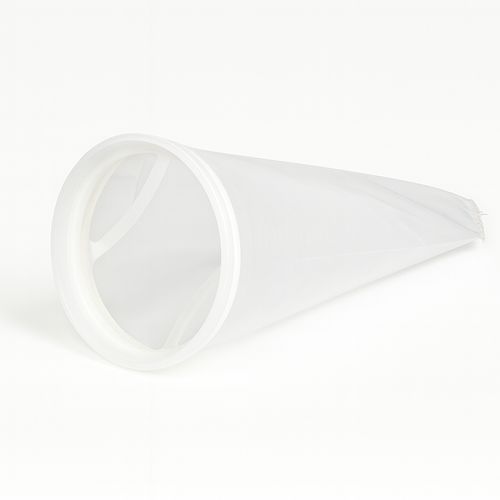
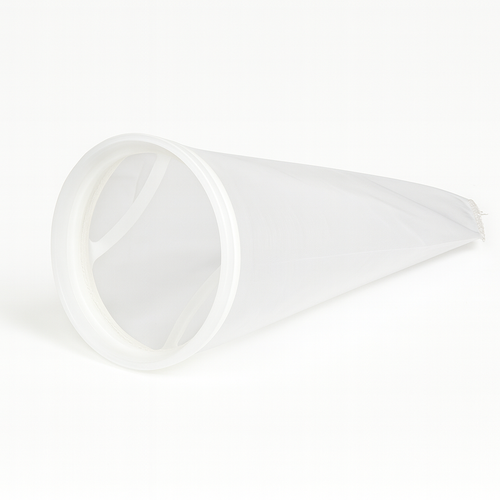
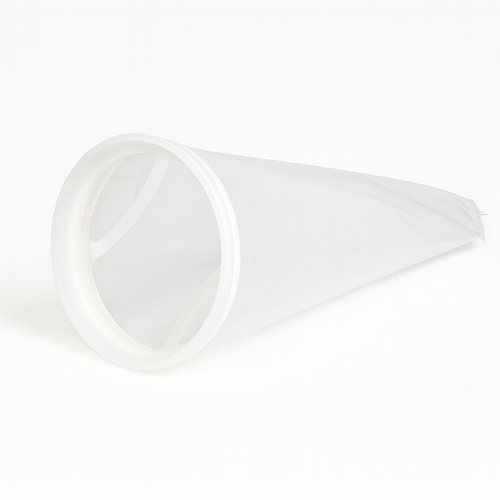

Technical reference
Mesh filter bag specifications and ordering information
Parent category: Liquid Filter Bags → Mesh Filter Bags
At-a-Glance Comparison (Mesh Families)
| Family | Material | Construction | Micron Range | Typical Max Temp | Best For |
|---|---|---|---|---|---|
| NMO | Nylon Monofilament | Single-fiber square weave | 1–1500 µm | ~275°F | Most precise surface cut; polishing and classification |
| NMU | Nylon Multifilament | Thread bundles (multi-strand) | 25–1500 µm | ~275°F | Higher dirt-holding vs monofilament; economical general use |
| PEMU | Polyester Multifilament | Thread bundles (multi-strand) | 100–1500 µm | ~275°F | Durable, stable polyester mesh; coatings and chemicals |
| POMO | Polypropylene Monofilament | Single-fiber woven | 100–800 µm | ~180°F | Excellent chemical resistance; high-flow straining |
Food contact: Polyester and polypropylene options are available that comply with CFR21 food-contact regulations. Silicone-free: All mesh families are available silicone-free. Need finer or specialty microns? Contact CFS for non-listed ratings and custom builds.
Micron Coverage by Mesh Family
Select your target particle size and choose the mesh family that offers the micron rating and construction best suited to your process. Monofilament provides the tightest, most repeatable openings; multifilament trades some precision for higher dirt-holding.
Availability Matrix
| Micron (µm) | NMO Nylon Mono |
NMU Nylon Multi |
PEMU Polyester Multi |
POMO PP Mono |
|---|---|---|---|---|
| 1–10 | • | |||
| 25–75 | • | • | ||
| 100–150 | • | • | • | • |
| 200–300 | • | • | • | • |
| 400–600 | • | • | • | • |
| 800 | • | • | • | • |
| 1000–1500 | • | • | • |
Standard Bag Sizes and Ring / Flange Styles
Sizes and Dimensions
| Bag Size | Diameter | Length | Notes |
|---|---|---|---|
| P1 | 7″ | 16″ | Most common |
| P2 | 7″ | 32″ | Double area vs P1 → lower ΔP |
| P3 | 4″ | 8″ | Compact |
| P4 | 4″ | 14″ | Compact |
Ring / Flange Options
| Code | Description | Construction | Typical Use |
|---|---|---|---|
| SH | Galvanized Steel Ring | Sewn | General purpose |
| SS | Stainless Steel Ring | Sewn | Corrosion resistance / food & chemical |
| P | P Flange (collar) | Sewn | Positive seal for compatible housings |
| F | F Flange (collar) | Sewn | Alternate collar profile / sealing |
| DS | Draw String | Sewn | Open-top vessels, low pressure |
Tip: Choose SS rings for aggressive chemistries or food contact. Use collar styles (P/F) for housings that require a positive seat/seal.
How to Choose Your Mesh Bag
Step-by-Step
- Define objective: Tight, repeatable cut → Monofilament (NMO, POMO). Higher capacity at similar µm → Multifilament (NMU, PEMU).
- Pick micron: Start with spec or lab test; reduce µm if target passes, increase if differential pressure rises too fast.
- Select size: P2 offers longer runs and lower ΔP vs P1; P3/P4 for compact spaces.
- Ring vs collar: Choose based on housing style and seal preference; upgrade to SS where corrosion or compliance matters.
- Temperature and chemistry: Nylon/polyester service to ~275°F; polypropylene to ~180°F; confirm compatibility for your fluid.
Common Application Matches
| Application | Recommended Family | Typical Microns | Notes |
|---|---|---|---|
| Water polishing / coolant filtration | NMO or NMU | 25–300 µm | NMO for precise cut; NMU for added dirt capacity |
| Paints / inks / coatings | NMO or PEMU | 50–400 µm | Consistent openings; polyester stable in many systems |
| Food & beverage (non-fiber shedding) | NMO or POMO | 100–400 µm | Contact CFS for compliant constructions |
| Chemical processing | NMO / PEMU / POMO | 50–800 µm | Match material to chemistry and temperature limits |
| Bulk solids removal / straining | POMO or NMU | 200–800 µm | High flow with good service life |
Shop by Mesh Family
- Nylon Monofilament (NMO) — Highest precision with square-weave openings, 1–1500 µm.
- Nylon Multifilament (NMU) — Economical with higher dirt capacity, 25–1500 µm.
- Polyester Multifilament (PEMU) — Durable polyester mesh, 100–1500 µm.
- Polypropylene Monofilament (POMO) — Chemically resistant monofilament, 100–800 µm.
Need help selecting a mesh family, micron, or ring/flange style? Talk to a CFS Filtration Specialist.
Need help selecting?
Start with the application or an existing part number.
CFS can help compare mesh material, construction, micron rating, bag size and seal style.